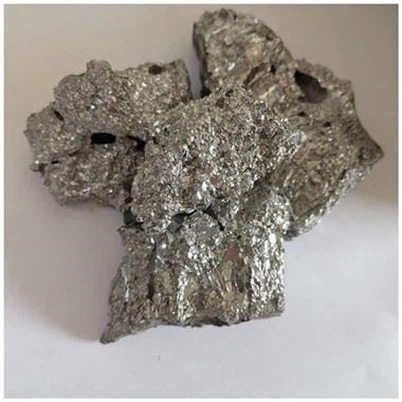

Ferro Vanadium 50, 10-220 mm: Definition and Applications
Leave a message
What Is Ferro Vanadium 50?
Ferro Vanadium 50 (FeV50) is an iron-vanadium master alloy with a nominal vanadium content of about 50%, typically assaying 48-55% vanadium. The remainder is iron plus controlled levels of silicon, aluminium, carbon, sulfur, and phosphorus. It is the standard economical carrier for adding vanadium to steel in bulk applications, produced by aluminothermic or silicothermic reduction of vanadium pentoxide.
What Does 10-220 mm Mean?
The 10-220 mm designation specifies the lump size range: pieces from about 10 mm up to 220 mm in their largest dimension. Large lumps suit big furnace and ladle additions where slow dissolution is acceptable, while the finer end of the range gives quicker melting for smaller additions. The size range is agreed with the supplier so the product matches the charging equipment and dissolution requirements.
Composition and Physical Specifications
| Parameter | Typical value | Note |
| Vanadium | 48-55% | Basis for pricing and dosing |
| Silicon | 2.0% max | Controlled impurity |
| Aluminium | 1.5-2.0% max | Affects inclusion formation |
| Carbon | 0.5% max | Controlled for steel chemistry |
| Lump size | 10-220 mm | Range agreed per order |
| Density | About 5.7-6.0 g/cm3 | Higher than slag, sinks into bath |
Specifications commonly reference GB/T 4139 for ferrovanadium; buyers should confirm the exact limits, sampling method, and test method in the contract.
Main Applications
HSLA steel: 0.02-0.15% vanadium refines grain and precipitates carbonitrides, raising yield strength with good weldability.
Construction steel and rebar: improved strength allows lighter sections for the same load.
Pipeline steel: strength and toughness combinations for gas and oil transport lines.
Cast iron: vanadium stabilizes carbides and refines structure, improving wear resistance.
Forgings and heavy sections: through-thickness strength and hardenability control.
Advantages of the 50% Grade
FeV50 is the most cost-efficient grade for bulk steelmaking: per tonne of alloy it is cheaper than FeV70 or FeV80, and the iron it introduces is acceptable in most structural grades. Large 10-220 mm lumps reduce fines losses and simplify handling with standard buckets and conveyors. For applications that tolerate the impurity and iron input, FeV50 delivers the same vanadium metallurgy at lower alloy cost.
Addition Practice and Recovery
Add FeV50 to the ladle after deoxidation with argon stirring. The required weight is the target vanadium weight divided by the lot assay and the expected recovery, which is normally above 95% in good practice. Larger lumps need adequate stirring time; excessive fines should be avoided because they are lost to slag and dust.
FAQ
1. How do I calculate the FeV50 addition for my heat?
Required alloy weight = (steel weight x target vanadium percentage) / (lot assay vanadium percentage x recovery). For 0.10% vanadium in 100 tonnes with 50% assay and 97% recovery, about 206 kg of FeV50 is needed.
2. Which lump size should I order?
Match the size to your addition method: large additions in big ladles can use 50-220 mm lumps; smaller heats and precise additions prefer 10-50 mm. Confirm the size distribution and fines limit in the contract.
3. Why is vanadium recovery sometimes low?
Recovery drops if the alloy is added to an oxidized bath, if fines are carried into slag, or if stirring is insufficient for large lumps. Add after full deoxidation and verify bath temperature and stirring intensity.
4. What impurities should I watch in FeV50?
Silicon, aluminium, carbon, sulfur, and phosphorus. Aluminium can form oxide inclusions; sulfur and phosphorus reduce toughness. Confirm the limits against your steel specification and the certificate of analysis.
5. Can I use FeV50 instead of FeV80?
Yes, in most structural and HSLA applications. Switch to FeV80 only when impurity input or dosing precision becomes critical, for example in tool steel or aerospace-adjacent grades. Compare on delivered cost per kilogram of contained vanadium.