

Pure Nickel Wire Manufacturing Process And Quality Control

Pure Nickel Wire Manufacturing Process and Quality Control Guide
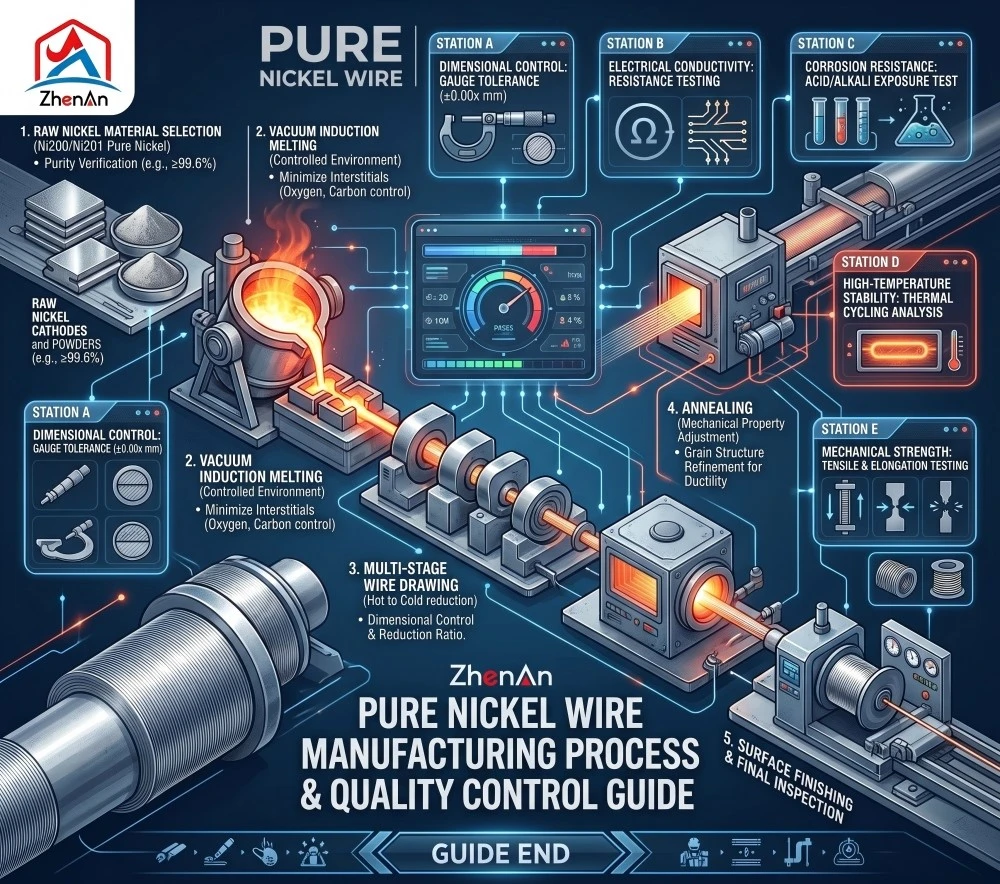
The quality of pure nickel wire depends not only on nickel purity but also on manufacturing processes, dimensional control, surface treatment, and inspection standards.
For industrial applications, buyers usually require more than a basic material specification. They need consistent nickel wire performance in areas such as:
Electrical conductivity
Corrosion resistance
High-temperature stability
Mechanical strength
Processing reliability
A professional nickel wire manufacturer must control the entire production process, from raw nickel material selection to final inspection.
This guide explains the complete pure nickel wire manufacturing process and the key quality control methods used for Ni200 and Ni201 nickel wire production.
What Is Pure Nickel Wire?
Pure nickel wire is a nickel-based metal wire manufactured from commercially pure nickel materials.
Common grades include:
| Grade | Nickel Content | Main Feature |
|---|---|---|
| Ni200 | ≥99.6% Ni | General pure nickel applications |
| Ni201 | ≥99.6% Ni | Lower carbon content for high-temperature applications |
Pure nickel wire combines:
Excellent corrosion resistance
Good electrical conductivity
High temperature resistance
Good ductility
Stable mechanical performance
Pure Nickel Wire Manufacturing Process
The production of pure nickel wire generally includes:
Raw material selection
Melting and chemical composition control
Casting
Wire drawing
Annealing treatment
Surface cleaning
Inspection
Packaging
Each stage influences the final product quality.
1. Raw Nickel Material Selection
The manufacturing process starts with selecting qualified nickel raw materials.
The quality of raw materials directly affects:
Nickel purity
Impurity control
Wire performance
Production consistency
Important chemical elements include:
Nickel (Ni)
Carbon (C)
Iron (Fe)
Copper (Cu)
Sulfur (S)
For high purity nickel wire production, raw materials must meet strict chemical requirements.
2. Nickel Melting and Composition Control
Selected nickel materials are melted under controlled conditions.
During melting, manufacturers monitor:
Melting temperature
Chemical composition
Material cleanliness
The purpose is to achieve:
Uniform chemical composition
Stable nickel content
Controlled impurity levels
For Ni201 nickel wire production, carbon content control is especially important.

3. Casting Process
After melting, liquid nickel is cast into suitable intermediate materials for wire production.
Casting quality affects:
Internal structure
Wire drawing performance
Final mechanical properties
Important factors include:
Material uniformity
Surface condition
Internal defects control
A stable casting process helps produce consistent nickel wire quality.
4. Wire Drawing Process
Wire drawing is the key process for converting nickel material into finished wire.
During wire drawing, the material passes through dies to gradually reduce diameter.
This process controls:
Wire diameter
Dimensional accuracy
Surface quality
Mechanical properties
Common nickel wire diameters include:
| Diameter Range | Typical Application |
|---|---|
| 0.025–0.1mm | Precision electronics |
| 0.1–0.5mm | Electroplating and industrial use |
| 0.5–1.5mm | Heating and industrial components |
| Customized sizes | Special applications |
5. Annealing Treatment
During wire drawing, nickel wire becomes harder due to work hardening.
Annealing is used to restore:
Ductility
Flexibility
Internal structure stability
Annealing helps improve:
Processing performance
Bending performance
Application reliability
The annealing process must be carefully controlled according to:
Nickel grade
Wire diameter
Final application
6. Surface Cleaning and Finishing
After wire production, surface treatment is performed to ensure clean and smooth wire quality.
Surface control includes:
Removal of surface contamination
Oxide control
Appearance inspection
High-quality nickel wire should have:
✓ Smooth surface
✓ Uniform appearance
✓ No cracks
✓ No visible defects
Surface quality is especially important for:
Electronics
Electroplating
Precision applications
Pure Nickel Wire Quality Control Process
A reliable nickel wire manufacturer applies inspection throughout production.
1. Chemical Composition Testing
Chemical analysis confirms that nickel wire meets grade requirements.
Inspection items include:
| Element | Purpose |
|---|---|
| Nickel (Ni) | Confirm purity level |
| Carbon (C) | Control Ni200/Ni201 differences |
| Iron (Fe) | Impurity control |
| Copper (Cu) | Composition verification |
| Sulfur (S) | Quality control |
Chemical testing ensures stable material performance.
2. Diameter Inspection
Diameter accuracy is critical for many applications.
Inspection includes:
Wire diameter measurement
Diameter tolerance
Batch consistency
Incorrect diameter may affect:
Electrical resistance
Equipment compatibility
Processing stability
3. Surface Quality Inspection
Surface inspection checks:
Smoothness
Cleanliness
Oxidation condition
Visible defects
A consistent surface helps improve:
Processing efficiency
Product reliability
4. Mechanical Property Testing
Depending on application requirements, nickel wire may be tested for:
Tensile strength
Elongation
Flexibility
These properties influence:
Forming performance
Installation process
Service conditions
5. Packaging and Final Inspection
Before shipment, finished nickel wire is checked for:
Coil weight
Packaging condition
Product identification
Specification confirmation
Proper packaging protects nickel wire during:
Storage
Transportation
Handling
Quality Factors to Consider When Buying Pure Nickel Wire
When selecting a nickel wire supplier, buyers should evaluate:
1. Nickel Grade
Confirm whether the application requires:
Ni200
Ni201
2. Chemical Composition
Request:
Material composition report
Inspection documentation
3. Diameter Accuracy
Confirm:
Required diameter
Tolerance range
Production consistency
4. Surface Quality
Check:
Surface cleanliness
Appearance
Defect control
5. Production Capability
A reliable manufacturer should have:
Controlled production process
Quality inspection system
Batch traceability
Common Manufacturing Problems and Their Impact
| Problem | Possible Impact |
|---|---|
| High impurity content | Reduced corrosion resistance |
| Poor diameter control | Processing problems |
| Surface defects | Reduced application performance |
| Insufficient annealing | Poor flexibility |
| Inconsistent batches | Unstable production results |
Pure Nickel Wire Technical Specifications
| Item | Specification |
|---|---|
| Product | Pure Nickel Wire |
| Grades | Ni200 / Ni201 |
| Nickel Content | ≥99.6% |
| Diameter | 0.025mm–Customized |
| Surface | Bright / Clean Surface |
| Production Method | Wire Drawing + Annealing |
| Application | Electronics, Electroplating, Vacuum, Industrial |
| Packaging | Coil / Spool |
FAQ: Pure Nickel Wire Manufacturing
1. How is pure nickel wire manufactured?
Pure nickel wire is produced through raw material selection, melting, casting, wire drawing, annealing, surface treatment, inspection, and packaging.
2. What is the difference between Ni200 and Ni201 production?
The main difference is carbon control. Ni201 requires stricter carbon content control for improved high-temperature performance.
3. Why is annealing important for nickel wire?
Annealing improves ductility and restores material properties after wire drawing.
4. How is nickel wire quality controlled?
Quality control includes:
Chemical composition testing
Diameter inspection
Surface inspection
Mechanical testing
Final packaging inspection
5. Can nickel wire be customized?
Yes. Nickel wire can be customized according to:
Grade
Diameter
Surface requirements
Packaging
Application conditions
Need Reliable Pure Nickel Wire?
Selecting the right nickel wire manufacturer is important for achieving stable application performance.
Provide your requirements:
Nickel grade (Ni200 / Ni201)
Wire diameter
Application
Quantity
Quality requirements
Our technical team can recommend a suitable pure nickel wire solution.

Contact Our Nickel Wire Team
WhatsApp: +86 15518824805
Email: info@zaferroalloy.com
Get:
✓ Ni200 / Ni201 nickel wire recommendations
✓ Technical specifications
✓ Quality information
✓ Customized solutions
✓ Competitive quotation


