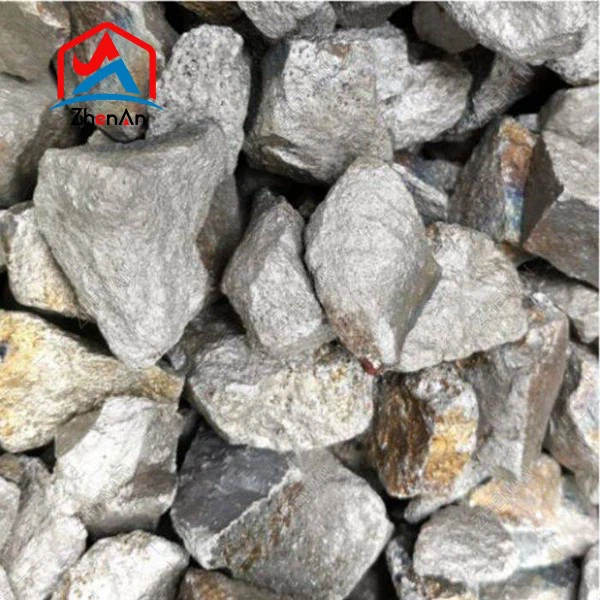

Introduction To The Properties Of Femo Ferromolybdenum
Leave a message
Introduction to the properties of Femo Ferromolybdenum
Molybdenum has a higher melting point. At high temperatures, molybdenum has a very low vapor pressure and a slow evaporation rate. The biggest feature of molybdenum is its strong electrical conductivity. Molybdenum is resistant to corrosion by inorganic acids, but can be quickly dissolved in a mixed solution of nitric acid and sulfuric acid.
Molybdenum and iron are miscible in any proportion. In the range of 1453-1813K, the compound MoFe (containing Mo63.29%) is stable in solid state. MO2Fe3 will crystallize below 1753K even if it is in the solid phase. When the molybdenum content is greater than 50%, the melting point of the alloy increases significantly. For example, the melting point of an alloy containing 60% molybdenum is 2073K, and ferromolybdenum with high molybdenum content cannot flow out of the furnace.
Molybdenum and carbon form carbides MO2C and MoC. The melting point of MO2C is 2653K and the melting point of MoC is 2843K. Complex carbides Fe3MO3C and Fe3CMO3C may also be generated. Molybdenum and silicon generate MO3Si, Mo5Si3, and MoSi2.
Molybdenum and aluminum form MoAl. Molybdenum and sulfur generate a series of sulfides, MoS2, MO2S3, and MoS3, among which MoS2 is the main sulfide. Molybdenite containing MoS2 is called molybdenite. When the temperature is greater than 673K, MoS2 is easily oxidized into MoO3 and MoO2.
Molybdenum and oxygen generate a series of oxides MoO3, MoO2, MO2O3, Mo4O11, etc., among which the most stable ones are MoO3 and MoO2. MoO3 has obvious acidity and is called molybdenum anhydride. It is a light green powder; it turns bright yellow when heated. The melting point is 978K, the boiling point is 1428K, the heat of formation is 746kJ/mo, and the density is 4.4g/cm3.
When the temperature is greater than 873K, MoO3 sublimates significantly. MoO3 is slightly soluble in water and can be dissolved in caustic alkali, soda, and ammonia solutions to form molybdate. MoO2 is a purple-brown powder with metallic luster.
When the temperature is greater than 1273K, MoO2 sublimates significantly, its heat of formation is 588.2kJ/mol, and its density is 6.34g/cm3. MoO2 is insoluble in water and alkaline aqueous solutions, and is also insoluble in acids such as sulfuric acid and hydrochloric acid.