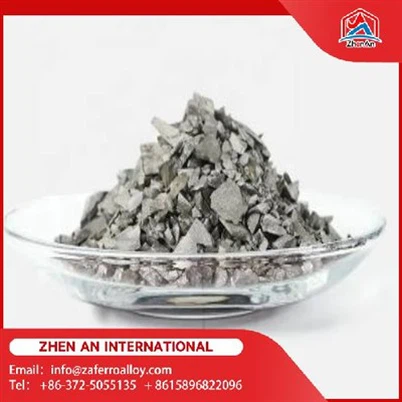

Ferrosilicon Uses in Steelmaking and Industrial Applications
Leave a message
What Ferrosilicon Is and How It Is Made
Ferrosilicon is a master alloy built from silicon and iron, produced by carbothermic reduction in submerged-arc electric furnaces. Quartz or quartzite is charged together with a carbon reductant such as metallurgical coke or charcoal, while an iron source - steel scrap, mill scale or iron ore - is added so that the reduced silicon dissolves in a metal phase instead of accumulating separately. The furnace is tapped at intervals, the liquid alloy is cast into beds or granulated, then cooled, crushed and screened into commercial size fractions.
The silicon content of the finished alloy is governed mainly by the charge ratio of quartz to iron together with furnace power, electrode position and slag practice. Commercial material is offered across a broad range of silicon levels, from roughly 45% to 80% Si, and the grade selected decides both the cost of the addition and its metallurgical effect in the ladle, converter or induction furnace. High-silicon grades are chosen when a large quantity of silicon must be introduced in a small weight of alloy; lower-silicon grades are chosen when a bulk, economical source of silicon is acceptable and the extra iron entering the heat does not disturb the final analysis.
Because the product is bought on chemistry and sizing rather than on appearance, a purchase is normally defined by four groups of variables: the grade designation and its nominal silicon level, the maximum aluminium content, the residual limits on carbon, sulphur and phosphorus, and the screened size fraction. Those variables explain nearly every difference in behaviour between two consignments that look like identical grey lumps of rock.
Standard Grades and Typical Chemical Composition
Traded grades are organised around a nominal silicon content, with aluminium-controlled variants available where the steel being treated is sensitive to residual aluminium. Grade designations and their limits follow the applicable ferrosilicon specification, GB/T 2272, and low-aluminium variants are designated by their maximum aluminium content, for example FeSi75Al0.5 and FeSi75Al1.0. Sampling and sample preparation for the certificate of analysis are performed to ISO 3713 or GB/T 4010, while the determination of silicon, aluminium, carbon, sulphur and phosphorus is covered by the methods in the GB/T 4333 series.
| Grade / variant | Typical Si (%) | Al max (%) | C max (%) | S max (%) | P max (%) | Typical use |
|---|---|---|---|---|---|---|
| FeSi75 | 74.0-80.0 | 1.5 | 0.15 | 0.02 | 0.04 | General steel deoxidation and alloying |
| FeSi75Al0.5 | 74.0-80.0 | 0.5 | 0.10 | 0.02 | 0.03 | Low-aluminium steels, electrical steels |
| FeSi75Al1.0 | 74.0-80.0 | 1.0 | 0.10 | 0.02 | 0.03 | Sheet and strip, welding consumables |
| FeSi72 | 72.0-76.0 | 2.0 | 0.20 | 0.02 | 0.04 | Routine steelmaking, cost-driven heats |
| FeSi65 | 65.0-72.0 | 2.0 | 0.20 | 0.02 | 0.04 | Feedstock for other alloys, bulk deoxidation |
| Low-silicon grade | 45.0-55.0 | 2.5 | 0.20 | 0.02 | 0.04 | Heavy-media powder, coarse silicon addition |
The values above are typical commercial ranges for guidance only; the binding limits are those of the grade written into the contract specification and confirmed by the certificate of analysis for the delivered batch. Aluminium deserves particular attention. It is the element most likely to vary between consignments of the same nominal grade, and in aluminium-killed or deep-drawing qualities it is often the aluminium content, not the silicon content, that determines whether a material is acceptable.
Ferrosilicon in Steelmaking: Deoxidation, Alloying and Slag Control
The largest single use of ferrosilicon is in iron and steel production. Silicon has a strong affinity for oxygen, so ferrosilicon is added as a deoxidiser at tapping or in the ladle to reduce the dissolved oxygen level and prevent gas porosity and oxide stringers in the cast product. The reaction is essentially the oxidation of dissolved silicon to silica, which then enters the slag phase. Because the reaction is exothermic and rapid, additions are usually made with a controlled feed rate rather than in a single lump, so that the alloy dissolves fully and the oxygen removal proceeds evenly across the ladle.
Beyond deoxidation, silicon is an alloying element in its own right. It raises hardness, strength and electrical resistivity in steel, and it is used to control the transformation behaviour of spring, tool, bearing and heat-resistant grades. In electrical steels the silicon level is deliberately taken into the range of roughly 1% to 3.5% Si to raise resistivity and reduce core loss, and the low-aluminium variants produced for this sector exist precisely because aluminium and nitrogen must be kept under tight control to protect magnetic properties. Typical deoxidation additions sit in the low single-digit kilogram per tonne of steel, adjusted to the oxygen content of the heat and the target silicon residual, while alloying additions are calculated directly from the mass balance between the aim analysis and the tap weight.
Ferrosilicon also supports slag control. By adjusting the silica potential of the slag it influences slag fluidity and the distribution of oxygen between metal and slag, which in turn affects the recovery of other additions. In duplex and ladle treatment routes, a measured ferrosilicon addition is frequently part of the sequence used with aluminium and calcium-silicon so that the final oxygen and inclusion level is reached in a predictable order rather than as a chance outcome of several simultaneous reactions.
Ferrosilicon in Cast Iron and Foundry Practice
In iron foundries ferrosilicon is used as an inoculant and as a silicon carrier. Inoculation is the late addition of a small quantity of a silicon-rich material to the tapped iron so that the graphite nucleates as fine, evenly distributed flakes or nodules instead of coarse or undercooled forms. The result is improved machinability, reduced chill depth and more uniform hardness across the casting section. Inoculants are commonly fine screened, from dust up to a few millimetres, so that they dissolve quickly before the metal solidifies.
A second and equally important foundry role is in the production of ductile iron. Nodularising agents are based on ferrosilicon carrying magnesium and often rare earths; the magnesium provides the nodularising effect while the ferrosilicon acts as the carrier and moderates the very violent magnesium reaction. The amount of nodulariser, the treatment temperature and the amount of post-inoculation silicon needed to reach the target silicon analysis are all calculated from the charge composition and the casting weight. It is normal to see several different ferrosilicon-based products in one foundry: a nodulariser for the treatment ladle, a fine inoculant for stream or mould inoculation, and a standard ferrosilicon for final silicon trimming.
Ferrosilicon as a Feedstock for Other Alloys
Ferrosilicon is also the silicon source for the manufacture of a family of other master alloys. Ferrosilicon-magnesium is produced by combining ferrosilicon with magnesium, ferrosilicon-calcium by reaction with calcium-bearing material, and ferrosilicon-chromium by introducing chromium units into the silicon-based alloy. Ferrosilicon powder is used in briquetting lines together with other alloy fines to recover material that would otherwise be lost as screen undersize, producing dense briquettes that charge cleanly and dissolve without excessive loss to the slag.
In this role the ferrosilicon grade matters in a different way from steelmaking. Aluminium, carbon, sulphur and phosphorus are all carried through into the downstream alloy, so a low-aluminium or tightly specified feed is often requested to prevent the finished master alloy from drifting outside its own specification. Similarly, the absence of fines, moisture and foreign contamination is treated as a quality characteristic rather than a handling detail, because briquetted or remelted products cannot be screened or blended afterwards.
Ferrosilicon in Welding, Chemical and Metallurgical Processes
Ferrosilicon is a standard deoxidiser in welding consumables. In flux-cored and covered-electrode manufacture it is blended into the flux or powder so that silicon is transferred to the weld pool, deoxidising the metal and stabilising the weld bead. The addition also compensates for silicon losses caused by slag reactions, keeping the weld metal analysis within the composition range required by the applicable consumable classification.
In chemical and metallurgical processing, ferrosilicon serves as a reducing agent and a source of silicon. One established industrial example is primary magnesium production, where fine ferrosilicon powder is mixed with calcined dolomite, briquetted and heated under vacuum; the silicon reduces the calcined dolomite and magnesium vapour is condensed as liquid metal. That route places strict demands on the fineness and reactive consistency of the ferrosilicon used. Ferrosilicon is also consumed in the production of silicon-based materials and in ore dressing, where milled ferrosilicon powder is suspended in water to create a dense medium for sink-float separation of coal, ore and diamond-bearing gravel; controlling the silicon content and the particle size distribution of the powder controls the density and therefore the cut point of the separation.
Silicon carbide manufacture consumes large volumes of a silicon-bearing source together with a carbon source in resistance furnaces, and ferrosilicon fines from screening and grinding are a conventional input to that charge. In diamond tool production, a fine metal powder mixture containing silicon is used as the matrix in which the abrasive crystals are held, and ferrosilicon chemistry contributes to the bonding and wear behaviour of that matrix.
The Silicon, Solar and Semiconductor Link
Ferrosilicon sits near the start of the silicon value chain. Quartzite reduced with carbon yields silicon metal, graded and traded under GB/T 2881 with designations such as Si 553, Si 441, Si 3303 and Si 2202, where the digits indicate the maximum contents of iron, aluminium and calcium. Silicon metal is then refined and upgraded, through chemical conversion and distillation steps, into polysilicon which is crystallised into ingots and sliced into wafers for solar cells and semiconductors. Chemical analysis for that chain is covered by the GB/T 14849 series.
It is important to be precise about the relationship. Ferrosilicon itself is not a direct feedstock for solar cells or semiconductor wafers: the silicon used in those products has to be far purer than an iron-bearing master alloy can be, with ppm and even ppb level control of boron and phosphorus, because those elements degrade carrier lifetime. What ferrosilicon shares with the photovoltaic sector is the upstream furnace, quartzite and reductant chain, and it is a genuine silicon source in the wider silicon field. The practical link for a purchaser of ferrosilicon is indirect but real: when quartzite and electric power costs move, the metallurgical silicon chain and the photovoltaic chain move together, so the two markets are influenced by the same energy and raw material fundamentals. Ferrosilicon also has a direct electrical use unrelated to purity, since silicon-alloyed electrical steels with high resistivity form the laminated cores of power transformers and motors.
Particle Size, Packaging and Acceptance
Sizing is specified on the purchase order and verified against the applicable particle-size requirements for ferroalloys, GB/T 13247, with oversize and undersize tolerances agreed in the contract. Screening, crushing and any subsequent handling all create fines, so the size declaration normally refers to the fraction at the point of packing, and a settled consignment may show a modest increase in fines after a long sea voyage.
| Screened fraction | Typical application | Handling consideration |
|---|---|---|
| 0-3 mm | Ladle and mould inoculation, briquetting, chemical use | High surface area, must be kept dry |
| 3-10 mm | Wire feeding, small additions, foundry inoculant | Free-flowing with limited fines |
| 10-50 mm | Standard steelmaking and foundry charge | Most widely traded export fraction |
| 10-100 mm | Induction furnace charging, bulk melting | Check dissolution rate in the ladle |
| 50-100 mm | Large electric furnace charging | Can bridge in small feed systems |
| Powder, 0-0.3 mm | Heavy-media separation, briquetting, sintering | Dust control and water-reactive gas risk |
Packaging follows GB/T 3650. Options include 25 kg or 50 kg woven bags, 1000 kg big bags, steel drums and lined bulk containers, each marked with grade, heat number, net weight and the applicable handling warning. On delivery, acceptance is normally based on a combination of the certificate of analysis for the heat, a size check on a representative sample, and an independent verification sample taken to ISO 3713 or GB/T 4010 where the buyer requires it. Documentary consistency matters as much as chemistry: grade, heat number, net weight and size fraction across the certificate, the packing list and the container seal should all match, and any discrepancy should be resolved before the material is charged.
Storage and transport call for one specific precaution. Ferrosilicon with a silicon content from 30% up to but not including 90% is classified under UN 1408, class 4.3, as a material which in contact with water may emit flammable gases. Moisture in contact with the alloy can generate hydrogen and small amounts of phosphine from residual phosphides, so the material should be stored under cover on a dry floor, with water ingress prevented during loading, and enclosed spaces such as holds or silos should be ventilated and gas-checked before entry. Fire-fighting and first-aid arrangements for contact with water-reactive dusty material should be in place wherever fine ferrosilicon is handled in bulk.
FAQ
Q: What is ferrosilicon mainly used for?
Its principal use is in iron and steel production, where it acts as a deoxidiser and a silicon alloying agent. It is also used as an inoculant in cast iron, as the carrier in magnesium-based nodularising agents, as a deoxidiser in welding consumables, as a reductant in magnesium smelting and as a dense-medium powder in mineral separation.
Q: What is the silicon content of FeSi75 ferrosilicon?
FeSi75 is a nominal 75% grade, typically supplied in the range of 74.0% to 80.0% Si, with aluminium commonly limited to 1.5% maximum, carbon to about 0.15% maximum, sulphur to 0.02% maximum and phosphorus to 0.04% maximum. The binding limits are those of the grade agreed in the contract under GB/T 2272.
Q: Why do steelmakers use ferrosilicon rather than pure silicon?
Ferrosilicon is far cheaper per unit of silicon, melts and dissolves readily in liquid steel, and introduces only iron as a balancing element, which is already the base metal. It is easier to store, charge and recover from slag than a light, friable silicon metal, and grade selection allows the silicon input to be matched to the aim analysis.
Q: How much ferrosilicon is added during steel deoxidation?
Routine additions are in the low single-digit kilograms per tonne of steel, calculated from the dissolved oxygen content of the heat, the target silicon residual and the silicon content of the grade used. Alloying heats for silicon-containing steels use larger calculated additions based on a straightforward mass balance against tap weight.
Q: Which ferrosilicon grade is used for cast iron inoculation?
Fine-screened, low-aluminium ferrosilicon around the 75% silicon level is typical for inoculation, because a low aluminium content reduces the risk of pinhole defects and hydrogen-related problems. Nodularising treatments instead use a ferrosilicon carrier holding magnesium, with the addition calculated from the sulphur level and the treatment weight.
Q: How is ferrosilicon stored and transported safely?
The alloy must be kept dry and under cover. Ferrosilicon with 30% to less than 90% silicon falls under UN 1408 class 4.3 because contact with water may release flammable gases including hydrogen, and residual phosphides can generate phosphine. Silos, holds and confined spaces should be ventilated and gas-checked before entry, and fine dust should be controlled with extraction rather than water washing.
Q: How is ferrosilicon quality verified on delivery?
Verification combines the heat certificate of analysis produced by methods in the GB/T 4333 series, a representative size check against GB/T 13247, and independent sampling to ISO 3713 or GB/T 4010 if required. Grade, heat number, net weight and size fraction must agree across the certificate, packing list and container seal before the material is accepted into production.