
High Purity Ferrovanadium
Leave a message
Ferro vanadium is the master alloy that carries vanadium into steel, and High Purity Ferrovanadium is one of the grades and applications in this product family. This guide explains the grade system, the production route, the chemistry that matters, and the steelmaking practice that uses it.
Ferro vanadium is the standard carrier of vanadium into steel.
Grades FeV40, FeV50, FeV60 and FeV80 differ by vanadium content.
Aluminothermic reduction of V2O5 is the main production route.
Vanadium refines grain and precipitates carbonitrides for strength.
Verify grade, vanadium content and impurities on the certificate.
What Is Ferro Vanadium?
Ferro vanadium is an iron-vanadium master alloy produced by reducing vanadium pentoxide (V2O5) with aluminium or silicon in the presence of iron. It is the standard way to add vanadium to steel, because the alloy form is dense, stable in storage and easy to dose into the melt. The vanadium content defines the grade, from FeV40 at about 35-50 percent vanadium up to FeV80 at 75-85 percent, and the grade is chosen by the steelmaker according to the alloying target and the furnace practice.
Grade System and Typical Chemistry
Chinese ferro vanadium grades are defined in GB/T 4139: FeV40 with vanadium 35-50 percent, FeV50 with 50-65 percent, FeV60 with 60-70 percent, and FeV80A and FeV80B with 75-85 percent. The impurity limits are also specified: aluminium, silicon, carbon, phosphorus and sulfur are held to grade-dependent maxima so that the addition does not disturb the steel chemistry. The mill certificate reports the vanadium content and each impurity element per lot, and buyers should verify the certificate against the ordered grade.
Production Process
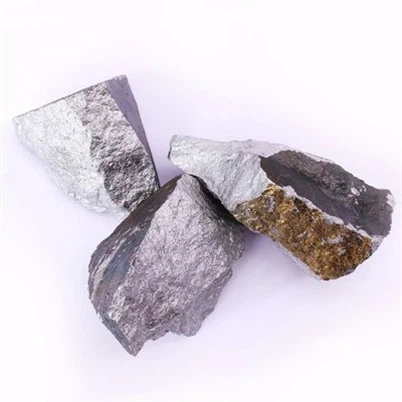
The dominant route is aluminothermic reduction: vanadium pentoxide, iron oxide or iron scrap, aluminium powder and a flux are charged together, and the exothermic reaction reduces the vanadium into a metal pool that separates from the slag. The result is a vanadium-iron ingot that is crushed and screened to the ordered particle size, typically 10-50 mm for steelmaking additions. Silicothermic and electro-silicothermic processes are used where aluminium content must be kept very low.
Role of Vanadium in Steel
Vanadium is a microalloying element with two jobs in steel. It forms fine vanadium carbonitrides that precipitate during rolling or heat treatment, giving grain refinement and precipitation strengthening; and it raises hardenability in quenched and tempered steels. This is how high-strength low-alloy (HSLA) plate, high-strength rebar, rail steel and tool steels reach their strength without heavy alloy additions, saving cost and improving weldability.
Applications by Grade
FeV40 and FeV50 are the workhorse grades for rebar and structural steel, where vanadium at 0.02-0.10 percent raises yield strength through precipitation hardening. FeV60 serves medium-alloy engineering steels. FeV80 and FeV80B are used where high vanadium recovery and low impurity pick-up matter, such as special steels and titanium alloys. Vanadium pentoxide and vanadium electrolytes also feed the vanadium redox flow battery and catalyst industries, which grow alongside the traditional steel market.
Buying and Quality Control
A ferro vanadium order should state the grade (for example FeV50), the vanadium content range, the impurity limits, the particle size range and the packaging. Each delivery should include a certificate of analysis with the vanadium and impurity results, and the product should be uniform within the lot so that steel chemistry stays consistent from heat to heat.
Frequently Asked Questions
It adds vanadium to steel as a master alloy: grain refinement and precipitation strengthening in rebar, HSLA plate, rails and tool steels.
They are the nominal vanadium content ranges: FeV40 is about 35-50 percent V, FeV50 50-65 percent, FeV60 60-70 percent, and FeV80 75-85 percent.
Mainly by aluminothermic reduction of vanadium pentoxide with aluminium in the presence of iron, followed by crushing and screening to size.
Typically 10-50 mm lumps for furnace additions; fines and powders are compacted or used in briquetting when recovery is critical.
Vanadium carbonitrides precipitate during the quenching and self-tempering process, raising yield strength so high-strength rebar meets grade without excessive carbon.
A certificate of analysis reporting vanadium and impurity elements per lot, the particle size range, and the packaging and marking details.