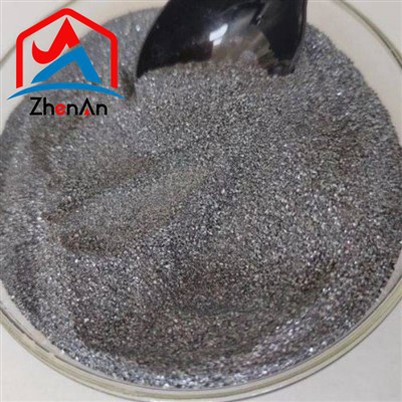
Ferrosilicon Nitride (FeSiN): Definition and Industrial Applications
Leave a message
What Is Ferrosilicon Nitride?
Ferrosilicon nitride (FeSiN) is a composite material formed by nitriding ferrosilicon. During production, ferrosilicon is heated in a nitrogen-rich atmosphere so that a portion of the silicon reacts to form silicon nitride within an iron-silicon matrix. The finished product combines ceramic-like hardness and chemical inertness with metallic thermal conductivity, giving it a stable, predictable behavior in molten metal processes.
How FeSiN Is Made
The manufacturing route starts with ferrosilicon feedstock, typically in lump or granule form. The material is charged into a kiln or reactor and exposed to nitrogen gas or ammonia at elevated temperature for a controlled period. The degree of nitridation determines the nitrogen content and the amount of silicon nitride formed. After cooling, the product is screened to the required size ranges, with granules of 10-100 mm being the most common industrial format.
Key Properties of FeSiN
| Property | Typical Characteristic | Benefit |
|---|---|---|
| Thermal stability | Retains structure at high temperatures | Suitable for molten metal treatment |
| Wear resistance | Hard ceramic phase | Long handling and dosing life |
| Chemical inertness | Low reactivity with furnace atmosphere | Predictable metallurgical response |
| Nitrogen supply | Controlled release from Si3N4 | Grain refinement and nodulization |
Main Industrial Applications
Ductile iron production: FeSiN acts as a nodulizer that promotes spheroidal graphite, improving strength, toughness and machinability of castings.
Steelmaking: the material serves as a nitrogen and silicon source, supporting grain refinement and alloying.
Inoculation: controlled additions refine the graphite structure of gray and ductile iron melts.
Refractory linings: thermal conductivity and oxidation resistance extend the service life of furnace components.
Special alloy additions: FeSiN supplies silicon and nitrogen without introducing excessive impurities.
FeSiN Compared with Magnesium Treatment
Traditional ductile iron production often relies on magnesium-based nodulizers, which can generate intense fumes and require careful safety handling. FeSiN offers a complementary route: it provides more consistent metallurgical results, lower fume generation and simpler handling, while still delivering the graphite control needed for high-quality ductile iron. This makes it attractive to foundries seeking both quality and operational safety.
FAQ
Q1: What is FeSiN made from? Ferrosilicon nitride is made from ferrosilicon and nitrogen, with silicon nitride formed as a functional phase inside an iron-silicon matrix.
Q2: Why is FeSiN used in ductile iron? It acts as a nodulizer that promotes spheroidal graphite, improving the strength, toughness and machinability of castings.
Q3: How is FeSiN produced? Ferrosilicon is heated in a nitrogen or ammonia atmosphere in a controlled nitridation process, then cooled and screened to size.
Q4: What size of FeSiN is typical for foundries? Granules of 10-100 mm are the standard industrial format, offering controlled dosing, low dust and efficient melting.
Q5: What are the safety advantages of FeSiN over magnesium nodulizers? FeSiN generates less fume, is easier to handle and delivers more consistent metallurgical results in ductile iron production.