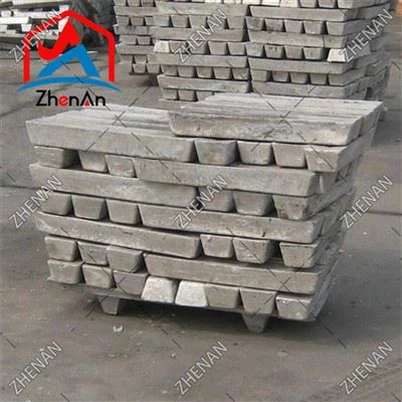

Ferrovanadium FeV80: Alloy Additive for HSLA and Linepipe Steel
Leave a message
Ferrovanadium as an Alloy Additive: What It Is and Why Steel Mills Use It
Ferrovanadium, usually written FeV, is a master alloy of vanadium and iron in which the vanadium content is concentrated so that a small, weighable addition to a ladle or furnace can deliver a tightly controlled vanadium residual in the finished steel. The two commercially dominant grades are FeV50, at roughly 50% vanadium, and FeV80, at roughly 80% vanadium. FeV80 is the grade of choice for most bulk steelmaking because its high vanadium content reduces the mass of material that must be handled, stored and added per heat, and because its lower proportion of iron and silicon makes the addition easier to balance against tight residual specifications.
Vanadium is added for a specific metallurgical reason: it is one of the strongest ferrite strengtheners available to a steelmaker, and it delivers that strengthening through a precipitation mechanism that can be controlled by composition and cooling rather than by elaborate heat treatment. A vanadium level of a few hundredths of a percent, combined with nitrogen, is enough to raise yield strength by well over a hundred megapascals in a hot-rolled structural or linepipe steel. That is why ferrovanadium sits alongside ferroniobium and ferrotitanium in the microalloying toolbox, and why its price and availability are watched so closely by steelmakers running HSLA and long-product programmes.
Grades, Chemical Composition and Reference Standards
In the Chinese standards system, ferrovanadium is specified under GB/T 4139, which defines the FeV50 and FeV80 families together with impurity ceilings for silicon, carbon, sulphur, phosphorus and aluminium. Export orders frequently reference GB/T 4139 alongside an agreed internal specification, and buyers in other regions often work to equivalent national or customer standards with the same grade designations. What matters in practice is that the certificate states the vanadium range, each impurity ceiling and the sampling method, because the differences between two nominally identical FeV80 lots usually appear in the impurity columns rather than in the vanadium figure.
| Parameter | FeV50 (typical) | FeV80 (typical) | Effect on steelmaking |
|---|---|---|---|
| V | 48.0 - 52.0% | 78.0 - 82.0% | Addition rate and cost per unit of vanadium |
| Si | 2.0% max | 1.5% max | Silicon adds to deoxidation load and can shift analysis |
| C | 0.40% max | 0.15% max | Critical for low-carbon and interstitial-free grades |
| Al | 2.0% max | 1.5% max | Residual from aluminothermic reduction; false deoxidation credit |
| S | 0.05% max | 0.03% max | Sulphide inclusions, especially in plate and linepipe |
| P | 0.10% max | 0.05% max | Toughness and welding; hard to correct downstream |
| Size | 10 - 50 mm lump | 10 - 50 mm lump, fines fraction declared | Dissolution rate and recovery |
Note that the vanadium figures are ranges, not single values, because ferrovanadium is a heterogeneous product: the alloy ingot or cake is not perfectly homogeneous, and the certified value is the mean of a properly taken sample. A supplier quoting a single number without a range and without a stated sampling protocol is giving an incomplete offer.
How Ferrovanadium Is Made
Essentially all commercial ferrovanadium is produced by reducing vanadium pentoxide with aluminium in a thermite-type reaction. The charge combines V2O5 flake, aluminium granules, iron or scrap to set the final grade, and lime or fluorspar to flux the alumina slag that forms. The reaction is strongly exothermic and self-sustaining once ignited, reaching temperatures well above the melting point of the alloy, so the product collects as a liquid pool beneath a molten alumina-rich slag and separates cleanly on cooling.
A second, older route uses silicon as the reductant in an electric furnace, with aluminium added for final trimming, and a third produces the alloy from vanadium-bearing slag or from vanadium carbide and oxide blends. The aluminothermic route dominates because it gives low carbon - an essential property, since ferrovanadium is often added to steels that must meet very low carbon specifications - and because it needs no furnace power beyond ignition.
Process control determines the properties that buyers care about. Excess aluminium in the charge raises the Al residual in the alloy and leaves metallic shot trapped in the slag. Insufficient reductant leaves vanadium in the slag as lower oxides and cuts recovery. Poor cooling practice creates shrinkage cavities and segregation, so the sampled analysis may not represent the whole lump. This is why a well-run supplier reports both the alloy analysis and the slag analysis, and why experienced buyers ask for the vanadium recovery figure rather than accepting the alloy assay in isolation.
Metallurgical Function: Grain Refinement and Precipitation Strengthening
Vanadium dissolved in austenite at hot-rolling temperature has limited solubility, and on cooling it comes out of solution as vanadium carbonitride, V(C,N). Two things follow. First, undissolved or freshly precipitated particles pin austenite grain boundaries and limit grain growth, giving a finer ferrite grain size after transformation. Second, the particles that precipitate in ferrite during and after transformation strain the lattice and raise yield strength by a precipitation-hardening increment. The combination - grain refinement plus precipitation strengthening - is why vanadium is so efficient per unit of addition.
The practical consequence is a strong interaction between vanadium and nitrogen. Vanadium carbonitride precipitation is favoured when nitrogen is available, and the strengthening effect at a given vanadium level rises markedly with nitrogen content up to the point where the available nitrogen is consumed. Steels microalloyed with vanadium are therefore often also treated with a small nitrogen addition, and the nitrogen level in the ladle must be known before the vanadium addition is set. Carbon level, by contrast, works in the opposite direction for a different reason: higher carbon increases the amount of cementite and changes the transformation temperatures, so the same vanadium addition produces a different strength in a 0.05% C steel than in a 0.15% C steel.
Vanadium also raises the tempering resistance of quenched and tempered steels. Tool steels and hot-work die steels rely on secondary hardening from vanadium-rich carbide precipitation, which is why ferrovanadium appears in the charge of grades such as those in the GB/T 1299 family even where the vanadium level is only around one percent.
Microalloying Practice in HSLA and Linepipe Steels
High-strength low-alloy steels are the largest single application. Typical vanadium additions in as-rolled structural and linepipe steels fall in the range of about 0.03% to 0.12% V, with the upper end used where strength must be achieved without accelerated cooling. Because vanadium raises strength without a separate heat treatment, it is well suited to heavy sections, thick plate and long products where through-thickness cooling rates are slow - the exact conditions in which niobium-only or niobium-titanium chemistries become less effective.
In thermomechanically controlled rolled plate, vanadium is often used as a complement to niobium rather than a substitute. Niobium controls austenite recrystallisation during roughing, while vanadium provides precipitation strengthening in the finished ferrite. Titanium is sometimes added at very low levels to protect the steel against nitrogen pickup in the weld heat-affected zone, because coarse TiN is more stable than VN at high temperature. A purchasing engineer comparing offers should therefore ask what full chemistry the microalloy package is designed for, not simply the ferrovanadium vanadium content.
Two acceptance consequences follow. First, yield strength in these steels is sensitive to vanadium variation, so a lot of FeV80 that assays at 79% rather than 81% will shift the strength of a tightly specified heat. Second, because the mechanism depends on dissolved vanadium, the dissolution behaviour of the additive matters: coarse lump that sits undissolved in the ladle slag gives a lower recovery than the certificate implies. Declared sizing, therefore, is a functional specification, not a handling convenience.
Principal Application Sectors
Oil and gas pipelines. Linepipe steels in the API Spec 5L X60 to X80 range use vanadium-bearing microalloyed chemistries to combine strength with toughness in the seam weld and heat-affected zone.
Structural and construction steel. High-strength sections, plate for buildings and bridges, and cold-formed profiles use vanadium to reach strength grades without quench and temper.
Rails and track components. Rail steels use vanadium for hardness and wear resistance in the head, along with controlled cooling.
Pressure vessels. Vanadium-modified Cr-Mo plate grades rely on vanadium carbides for elevated-temperature strength and creep resistance.
Forging and automotive bar. Microalloyed forging steels use vanadium so that strength can be obtained in the as-forged condition, avoiding a separate quench and temper operation.
Tool and die steels. Vanadium carbides give wear resistance and temper stability in cold-work and hot-work grades.
Each sector imposes its own constraint on the ferrovanadium specification. Pipeline work is sensitive to sulphur and phosphorus because of inclusion-driven toughness loss. Pressure-vessel work is sensitive to carbon and to the aluminium residual. Automotive forging is sensitive to vanadium consistency heat to heat, because the same chemistry is expected to hit the same strength band every shift.
Addition Practice, Recovery and Quality Control
FeV80 is normally added to the ladle during tapping or in the final stage of secondary metallurgy, after deoxidation has progressed enough that the alloy will dissolve into a liquid steel bath rather than being oxidised and lost to slag. Recovery in routine ladle practice generally falls in the range of about 90% to 95%, and it drops when the bath is oxidised, when the addition is made too early or too late, or when the lump size is too coarse for the stirring energy available. Ferrovanadium has a density close to that of steel, so it sinks into the bath rather than floating, which is an advantage over lighter additions such as ferrosilicon.
Handling requirements are straightforward but often neglected. Lumps should be dry and free of surface rust and fines; moisture on the surface of ferrovanadium produces hydrogen pickup and porosity. Fines below a few millimetres should be quantified and either briquetted or excluded, because they are oxidised before they dissolve. Storage should be under cover on a dry floor, away from acids and water, with FIFO stock rotation so that older material does not absorb moisture in a humid climate.
For acceptance, three checks are worth building into the contract. Verify the vanadium content on a sample taken from the delivered lots by a defined procedure rather than from a supplier-composite sample. Verify the carbon and aluminium levels if the melting shop runs low-carbon or aluminium-controlled grades. And verify the size distribution against the declared window, because a load that meets the chemical specification but is 70% fines is functionally off-specification. Third-party inspection before shipment is inexpensive relative to the cost of a failed heat.
Commercial Considerations in Sourcing Ferrovanadium
Ferrovanadium is one of the more volatile master alloys in terms of price, because its cost is dominated by the vanadium units it carries, which in turn depend on vanadium pentoxide availability, steel demand in the microalloying segment, and the energy and reductant costs of the upstream conversion route. Buyers should therefore treat the vanadium content as the priced basis and evaluate offers on a cost-per-kilogram-of-vanadium basis rather than on price per tonne of alloy, since FeV50 and FeV80 are not interchangeable on a weight-for-weight comparison.
The quotation should be unambiguous about the price basis - ex-works, FOB or CIF - and about the incoterms, packaging, and whether the analysis is guaranteed on a dry basis. It should also state the currency, the validity period and the treatment of the vanadium range: if the alloy is sold as 78% to 82% V, the value of a lot at the bottom of the range should be adjusted, not accepted as equivalent to the top. Finally, documentation should include the certificate of analysis, the packing list with net and gross weights, and any inspection certificate required at the destination port.
FAQ
Q: What is the difference between FeV50 and FeV80 in practice?
Both are ferrovanadium produced by aluminothermic reduction. FeV80 carries roughly 78% to 82% vanadium with tighter carbon and silicon limits, so it adds less dead weight and less carbon per unit of vanadium; FeV50 at about 48% to 52% vanadium is cheaper per tonne but requires a larger addition for the same vanadium recovery.
Q: Why does nitrogen control matter when adding ferrovanadium?
Vanadium strengthens steel mainly through vanadium carbonitride precipitation, and nitrogen participates in that precipitation. At a fixed vanadium level, raising available nitrogen increases the strength increment, so the nitrogen analysis of the bath must be known before the vanadium addition is finalised.
Q: What vanadium recovery should a steelmaker expect from a ladle addition?
Roughly 90% to 95% is normal in well-controlled ladle practice. Recovery falls when the bath is oxidised, when additions are made at the wrong point in tapping, when lump size is too coarse for the available stirring energy, or when the charge contains excessive fines.
Q: Which standard governs ferrovanadium composition?
GB/T 4139 specifies the FeV50 and FeV80 grades with their impurity ceilings. Export orders commonly reference GB/T 4139 together with an agreed purchaser specification, and the purchase order should state the vanadium range, each impurity limit and the sampling and assay methods used for acceptance.
Q: Can ferrovanadium be added to a low-carbon steel without raising carbon?
Yes, which is why the aluminothermic route dominates. FeV80 is normally specified at about 0.15% C maximum and FeV50 at about 0.40% maximum, so at typical addition rates of a few kilograms per tonne the carbon contribution is small; the aluminium residual is usually a more significant consideration.
Q: How is the strength contribution of vanadium estimated for a new heat?
It is estimated from the dissolved vanadium and nitrogen levels using the solubility and precipitation behaviour of V(C,N), then confirmed by trial heats and tensile testing, because the actual increment depends on carbon content, rolling schedule, finish temperature and cooling rate as much as on the vanadium addition itself.