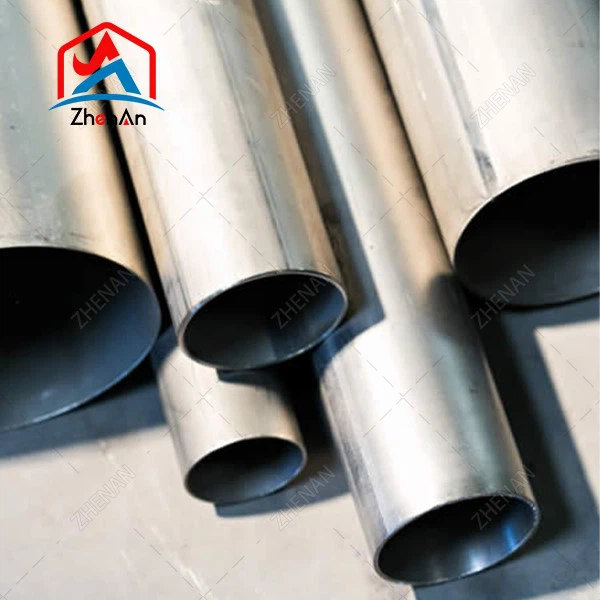

Titanium Tube Manufacturing Process: Seamless Vs Welded Tubes, Grades And Applications
Leave a message

Titanium Tube Manufacturing Process: Seamless vs Welded Tubes, Grades and Applications
1. What Are Titanium Tubes?
Titanium tubes are hollow cylindrical products manufactured from commercially pure titanium or titanium alloys. They are widely used in industries requiring high corrosion resistance, lightweight performance and reliable mechanical strength.
Titanium tubes are valued for their unique combination of properties:
Excellent corrosion resistance in seawater and chemical environments
High strength-to-weight ratio
Good performance at elevated temperatures
Resistance to many aggressive chemicals
Long service life compared with conventional metals
Depending on production method, titanium tubes are mainly divided into:
Seamless titanium tubes
Welded titanium tubes
The selection depends on application requirements, pressure conditions, dimensional requirements and cost considerations.
2. Titanium Tube Manufacturing Process Overview
The production of titanium tubes requires strict process control because titanium reacts easily with oxygen, nitrogen and hydrogen at elevated temperatures.
Typical manufacturing steps include:
Titanium billet or strip preparation
Tube forming
Heat treatment
Surface treatment
Straightening
Non-destructive testing
Final inspection and packaging
Advanced equipment and controlled production environments are required to maintain chemical composition, mechanical properties and dimensional accuracy.
3. Seamless Titanium Tube Manufacturing Process
Seamless titanium tubes are produced from solid titanium billets without a welded seam.
3.1 Billet Preparation
Titanium billets are inspected and heated before forming.
The billet quality affects:
Tube strength
Surface quality
Internal defects
3.2 Extrusion or Rotary Piercing
The heated billet is processed through:
Hot extrusion
Rotary piercing
This creates a hollow tube shell.
3.3 Cold Pilgering and Rolling
The tube shell is reduced to the required:
Outer diameter
Wall thickness
Mechanical properties
Cold pilgering is commonly used for precision titanium tubes.
3.4 Finishing Process
Final processing includes:
Pickling
Straightening
Surface cleaning
Dimensional inspection
Seamless titanium tubes are preferred for applications requiring:
High pressure resistance
Superior reliability
Critical service conditions
4. Welded Titanium Tube Manufacturing Process
Welded titanium tubes are manufactured from titanium strip or sheet that is formed into a tubular shape and joined by longitudinal welding.
4.1 Strip Preparation
Titanium strips are prepared according to:
Required tube size
Thickness
Grade specification
4.2 Tube Forming
The strip is gradually formed into a cylindrical shape through forming equipment.
4.3 Titanium Welding Process
Titanium welding requires strict protection because molten titanium reacts strongly with:
Oxygen
Nitrogen
Hydrogen
To prevent contamination, welding requires:
High-purity argon shielding
Weld root protection
Controlled welding parameters
4.4 Weld Inspection
Welded tubes are inspected through:
Visual examination
Dimensional testing
Non-destructive testing
Welded titanium tubes are widely used where large quantities, consistent dimensions and cost efficiency are required.
5. Seamless Titanium Tube vs Welded Titanium Tube
| Comparison | Seamless Titanium Tube | Welded Titanium Tube |
|---|---|---|
| Manufacturing Method | Extrusion, piercing, cold pilgering | Strip forming and welding |
| Weld Seam | None | Longitudinal weld |
| Pressure Resistance | Higher | Suitable for standard pressure applications |
| Production Efficiency | Lower | Higher |
| Cost | Generally higher | More economical |
| Typical Applications | Aerospace, high-pressure systems | Heat exchangers, industrial equipment |
The correct choice depends on application requirements, operating conditions and budget.
6. Titanium Tube Grades and Standards
Titanium tubes are commonly supplied according to ASTM and ASME standards.
Common Titanium Grades
| Grade | Characteristics | Typical Applications |
|---|---|---|
| Grade 1 | Excellent corrosion resistance, high ductility | Chemical equipment, heat exchangers |
| Grade 2 | Balanced strength and corrosion resistance | Condensers, seawater systems, industrial tubing |
| Grade 5 (Ti-6Al-4V) | High strength titanium alloy | Aerospace structures, high-performance components |
| Grade 9 (Ti-3Al-2.5V) | Good strength and formability | Hydraulic tubing, bicycle frames |
| Grade 12 (Ti-0.3Mo-0.8Ni) | Enhanced corrosion resistance | Chemical processing equipment |
7. Titanium Tube Specifications
Titanium tubes can be customized according to application requirements.
Typical specifications include:
| Parameter | Typical Range |
|---|---|
| Outer Diameter | 6–219 mm |
| Wall Thickness | 0.5–10 mm |
| Length | Standard length or customized |
| Surface Finish | Pickled, polished or customized |
| Production Type | Seamless or welded |
| Standards | ASTM B338, ASTM B861, ASTM B862 |
Final dimensions depend on customer drawings, equipment requirements and industry standards.
8. Titanium Tube Applications
8.1 Heat Exchangers and Condensers
Titanium tubes are widely used in:
Power plant condensers
Seawater heat exchangers
Chemical processing equipment
Advantages:
Excellent seawater corrosion resistance
Low maintenance requirements
Long operating life
8.2 Aerospace Industry
Titanium alloy tubes are used in aerospace applications because of their:
High strength-to-weight ratio
Fatigue resistance
Corrosion resistance
Applications include:
Hydraulic systems
Aircraft structures
Engine-related components
8.3 Medical Applications
Titanium tubes and titanium alloys are used in medical fields due to their:
Biocompatibility
Corrosion resistance
Mechanical strength
Applications include:
Medical devices
Implant-related components
Surgical equipment
8.4 Chemical Processing
Titanium tubes are suitable for aggressive chemical environments involving:
Chlorides
Acids
Seawater
9. Titanium Tube Quality Control
Reliable titanium tube production requires strict quality inspection.
Typical inspections include:
Chemical Analysis
Verification of:
Titanium content
Alloying elements
Impurity limits
Mechanical Testing
Including:
Tensile strength
Yield strength
Elongation
Dimensional Inspection
Checking:
Outer diameter
Wall thickness
Length
Straightness
Non-Destructive Testing
Depending on requirements:
Eddy current testing
Ultrasonic testing
Hydrostatic testing
Quality documents may include:
Mill Test Certificate (MTC)
Inspection report
Material certificate
10. Titanium Tube Buying Guide
Before purchasing titanium tubes, buyers should confirm:
Material Requirements
Titanium grade
Chemical composition
Mechanical properties
Tube Requirements
Seamless or welded type
Diameter
Wall thickness
Length
Surface condition
Application Requirements
Specify:
Working temperature
Pressure conditions
Corrosion environment
Industry standard
Documentation
Request:
MTC
Inspection reports
Compliance certificates
11. Frequently Asked Questions
What is the difference between seamless and welded titanium tubes?
Seamless tubes have no weld seam and are generally selected for higher pressure or critical applications. Welded tubes are more economical and suitable for many industrial applications.
Which titanium grade is commonly used for heat exchangers?
Titanium Grade 2 is one of the most commonly used grades for heat exchangers and condenser tubing.
What standards apply to titanium tubes?
Common standards include ASTM B338 for heat exchanger tubes, ASTM B861 for seamless pipe and ASTM B862 for welded pipe.
Why is argon shielding required when welding titanium?
Titanium reacts easily with oxygen, nitrogen and hydrogen at high temperatures. Argon shielding prevents contamination and maintains weld quality.
Are titanium tubes corrosion resistant?
Yes. Titanium tubes have excellent resistance to seawater, chlorides and many chemical environments.
What information should buyers provide when ordering titanium tubes?
Buyers should specify grade, tube type, dimensions, standards, application conditions and inspection requirements.

Titanium Tube Supply for Industrial Applications
We provide titanium tubes including seamless and welded titanium tubes with customized grades, dimensions and inspection requirements for heat exchangers, chemical processing, aerospace and industrial applications.
Available according to ASTM standards with supporting quality documentation.
WhatsApp: +86 15518824805
Email: info@zaferroalloy.com