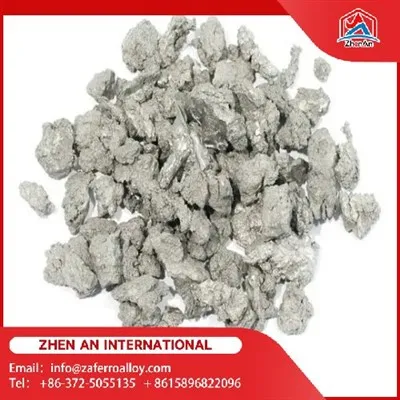
Ferrosilicon is produced via carbothermic reduction in an electric arc furnace (EAF) or blast furnace (less common). The process involves heating silica (SiO₂) with carbon (coke) and iron sources to produce silicon and ferrosilicon alloys. Below is a step-by-step breakdown:
Manufacturing Process Steps:
|
|
|
|
|
|
1. Raw Material Preparation
|
Quartzite (SiO₂), coke, and iron scrap are crushed and mixed in specific ratios (e.g., for FeSi 75, ~75% Si).
|
|
Particle size optimized for furnace efficiency.
|
|
2. Charging the Furnace
|
The mixture is loaded into an electric arc furnace (EAF) or submerged arc furnace (SAF).
|
|
Temperature: 1600–1800°C (for Si production).
|
|
3. Carbothermic Reduction
|
High heat reduces SiO₂ to silicon (Si) using carbon (coke):
SiO₂ + 2C → Si + 2CO↑
|
Endothermic reaction (requires high energy).
|
Carbon monoxide (CO) gas is released.
|
|
4. Silicon Formation & Alloying
|
The silicon reacts with iron (from scrap/pig iron) to form ferrosilicon (FeSi).
|
Si + Fe → FeSi (alloy)
|
Alloy composition varies (e.g., FeSi 45, FeSi 75).
|
|
|
Molten FeSi is tapped from the furnace and cast into molds or ingots.
|
|
Cooling forms solid FeSi lumps/blocks.
|
|
6. Crushing & Packaging
|
The solidified FeSi is crushed into lumps, grits, or powders for industrial use.
|
|
Stored in dry conditions to prevent moisture reactions.
|
Key Manufacturing Methods:
Electric Arc Furnace (EAF): Most common method, using graphite electrodes to generate high heat.
Submerged Arc Furnace (SAF): More energy-efficient, used for large-scale production.
Blast Furnace (Rare): Older method, less efficient than EAF/SAF.
The silicon content in ferrosilicon varies (e.g., FeSi 45, FeSi 75, FeSi 90), depending on the SiO₂-to-coke ratio.