

High Purity Nickel Wire Selection Guide: How To Choose The Right Nickel Wire For Your Application

High Purity Nickel Wire Selection Guide: How to Choose the Right Nickel Wire for Your Application
Selecting the right high purity nickel wire requires more than simply choosing a high nickel content material.
Different industries have different requirements for:
Nickel grade
Chemical composition
Wire diameter
Surface quality
Mechanical properties
Operating environment
For example:
Electroplating companies focus on stable dissolution and surface cleanliness.
Electronics manufacturers require precise diameter control and consistent conductivity.
Vacuum and high-temperature industries require low carbon content and thermal stability.
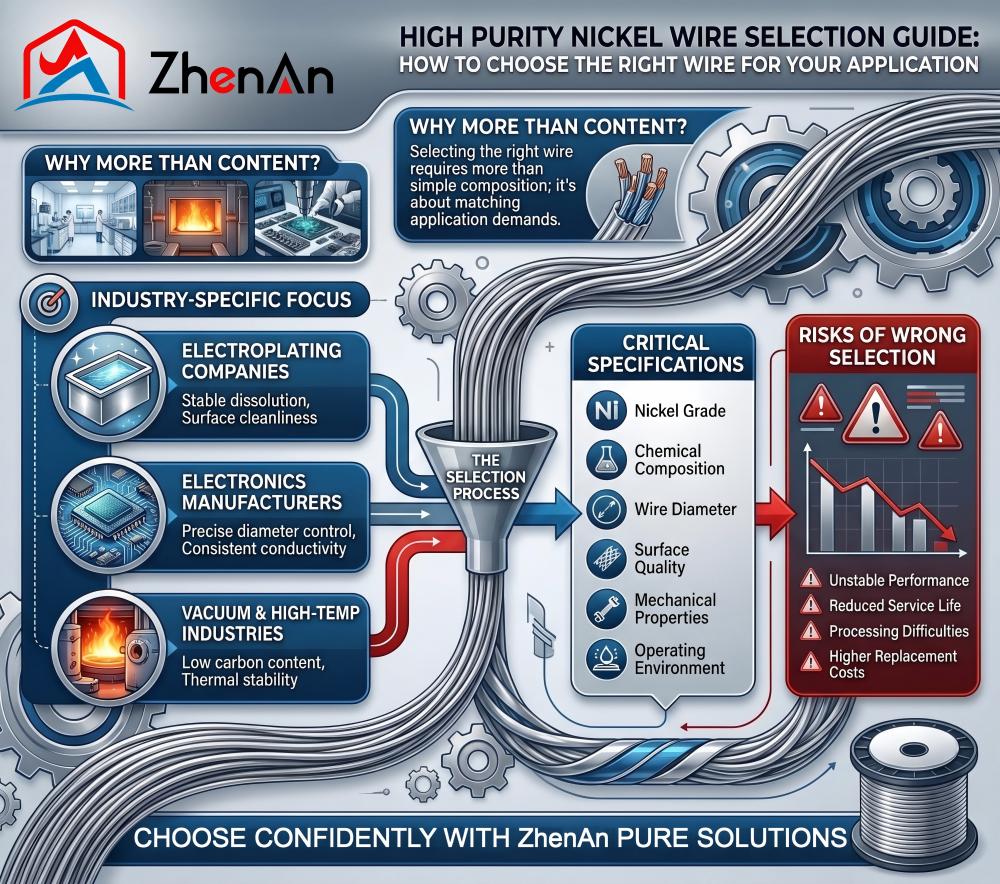
Choosing the wrong nickel wire specification may result in:
Unstable production performance
Reduced service life
Processing difficulties
Higher replacement costs
This guide explains how to select the right high purity nickel wire based on application requirements.
What Is High Purity Nickel Wire?
High purity nickel wire is a nickel-based metal wire produced with controlled chemical composition and dimensional accuracy.
Nickel has excellent properties including:
High corrosion resistance
Good electrical conductivity
High temperature resistance
Magnetic properties
Good mechanical strength
Because of these properties, pure nickel wire is widely used in:
Electroplating
Electronics
Vacuum equipment
Chemical processing
Battery-related applications
Aerospace components
High Purity Nickel Wire Grades
The most common commercially pure nickel wire grades are:
| Grade | Nickel Content | Main Feature |
|---|---|---|
| Ni200 Nickel Wire | ≥99.6% Ni | General pure nickel applications |
| Ni201 Nickel Wire | ≥99.6% Ni | Lower carbon content, improved high-temperature performance |
Ni200 Nickel Wire: General Industrial Choice
Characteristics
Ni200 is commercially pure nickel with:
High nickel content
Excellent corrosion resistance
Good electrical properties
Good mechanical performance
Typical Applications
Ni200 nickel wire is commonly used for:
Electroplating
Electrical components
Chemical equipment
Industrial applications
Choose Ni200 When:
✓ The working temperature is moderate
✓ General corrosion resistance is required
✓ Standard pure nickel performance meets requirements
Ni201 Nickel Wire: For High Temperature Applications
Characteristics
Ni201 is a low-carbon version of commercially pure nickel.
The reduced carbon content improves performance under prolonged high-temperature conditions.
Typical Applications
Ni201 nickel wire is often selected for:
Vacuum equipment
High-temperature components
Electronic applications
Chemical processing systems
Choose Ni201 When:
✓ The application involves elevated temperatures
✓ Long-term heating conditions exist
✓ Carbon control is important
Ni200 vs Ni201 Nickel Wire Comparison
| Item | Ni200 Nickel Wire | Ni201 Nickel Wire |
|---|---|---|
| Nickel Content | ≥99.6% | ≥99.6% |
| Carbon Content | Higher | Lower |
| Corrosion Resistance | Excellent | Excellent |
| Electrical Conductivity | Good | Good |
| High Temperature Stability | Good | Better |
| Vacuum Application | General | Preferred |
| Cost | Usually lower | Usually higher |
How to Choose Nickel Wire Diameter?
Nickel wire diameter directly affects:
Electrical resistance
Mechanical strength
Flexibility
Processing performance
Application suitability
Common diameter ranges:
| Diameter Range | Typical Applications |
|---|---|
| 0.025–0.1mm | Precision electronics, sensors |
| 0.1–0.5mm | Electroplating, electrical components |
| 0.5–1.5mm | Industrial components, heating applications |
| Above 1.5mm | Heavy-duty industrial applications |
Fine Nickel Wire
Diameter Range:
0.025mm–0.1mm
Applications:
Precision electronic components
Sensors
Micro devices
Key Requirements:
Accurate diameter tolerance
Smooth surface
Good flexibility
Medium Diameter Nickel Wire
Diameter Range:
0.1mm–0.5mm
Applications:
Electroplating
Electrical connection parts
Industrial applications
Advantages:
Balanced strength
Good processing performance
Large Diameter Nickel Wire
Diameter Range:
Above 0.5mm
Applications:
Industrial heating components
Chemical equipment
Structural parts
Advantages:
Higher mechanical strength
Better load resistance
How to Choose Nickel Wire Based on Application?
Nickel Wire for Electroplating
Electroplating applications require:
High nickel purity
Stable dissolution behavior
Clean surface
Consistent wire diameter
Recommended:
Ni200 High Purity Nickel Wire
Typical uses:
Decorative plating
Functional coatings
Metal finishing processes
Nickel Wire for Vacuum Applications
Vacuum environments require:
Low carbon content
High temperature stability
Low impurity levels
Recommended:
Ni201 Nickel Wire
Applications:
Vacuum furnaces
Electronic vacuum systems
High-temperature equipment
Nickel Wire for Electronics
Electronic applications require:
Precise dimensions
Stable electrical performance
Clean surface quality
Important specifications:
Diameter tolerance
Chemical composition
Surface condition
Nickel Wire for Chemical Industry
Nickel wire is selected for chemical applications because of:
Corrosion resistance
Chemical stability
Long service life
Applications:
Chemical equipment
Laboratory components
Processing systems
Key Quality Factors When Buying High Purity Nickel Wire
1. Chemical Composition
Important elements include:
Nickel (Ni)
Carbon (C)
Iron (Fe)
Copper (Cu)
Sulfur (S)
Chemical control is especially important for:
Vacuum applications
Electronics
High-temperature environments
2. Diameter Accuracy
Check:
Nominal diameter
Diameter tolerance
Batch consistency
Accurate diameter helps ensure:
Stable processing
Equipment compatibility
Consistent performance
3. Surface Quality
High-quality nickel wire should have:
Smooth surface
Uniform appearance
No cracks
No visible contamination
Surface quality is important for precision applications.
Common Mistakes When Selecting Nickel Wire
Mistake 1: Only Comparing Nickel Content
Nickel content is important, but it is not the only factor.
Buyers should also consider:
Carbon content
Diameter accuracy
Surface quality
Application conditions
Mistake 2: Choosing Ni200 for Extreme High Temperature Applications
Ni200 performs well in many industrial environments.
However, Ni201 may provide better suitability for long-term high-temperature applications due to its lower carbon content.
Mistake 3: Ignoring Diameter Requirements
The same nickel grade with different diameters can have different:
Resistance values
Flexibility
Strength
Diameter selection should match the actual application.
High Purity Nickel Wire Specifications
| Item | Specification |
|---|---|
| Product | High Purity Nickel Wire |
| Grades | Ni200 / Ni201 |
| Nickel Content | ≥99.6% |
| Diameter | Customized |
| Surface | Bright / Clean Surface |
| Application | Electroplating, Electronics, Vacuum, Industrial |
| Packaging | Coil / Spool |
| Customization | Available |
High Purity Nickel Wire Manufacturing Process
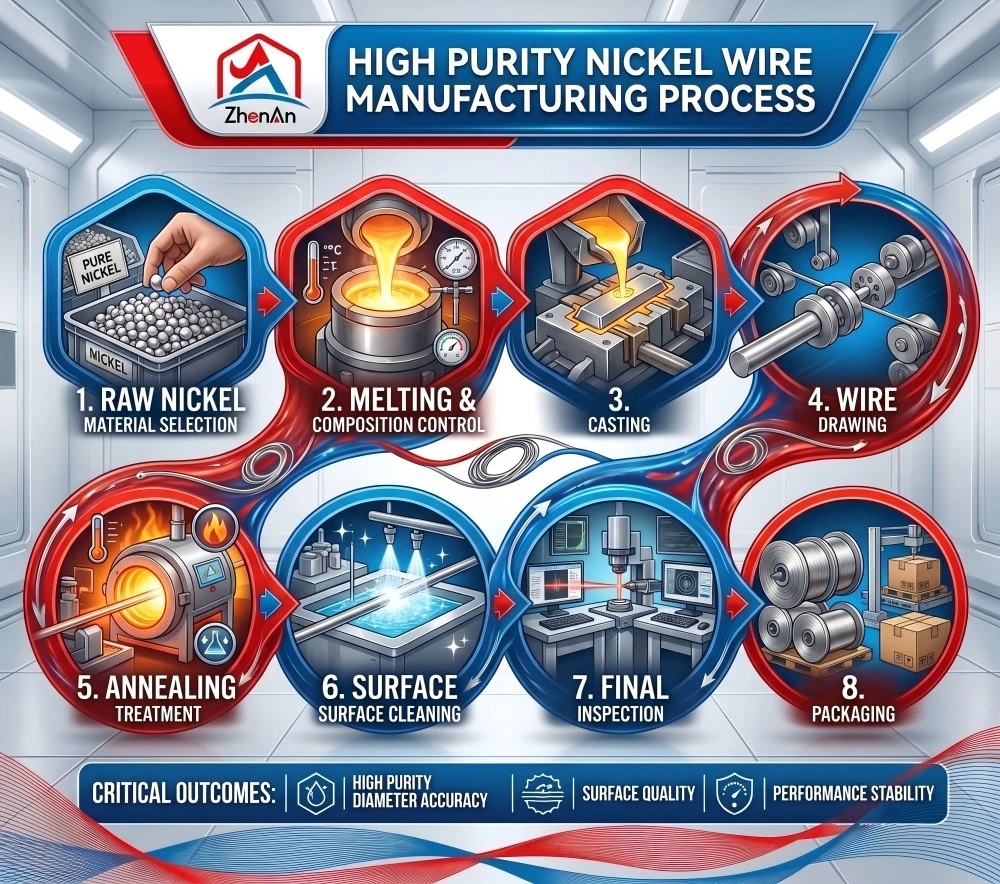
A professional nickel wire production process generally includes:
1. Raw Nickel Material Selection
↓
2. Melting and Chemical Composition Control
↓
3. Casting
↓
4. Wire Drawing
↓
5. Annealing Treatment
↓
6. Surface Cleaning
↓
7. Final Inspection
↓
8. Packaging
Each production stage affects the final:
Purity
Diameter accuracy
Surface quality
Performance stability
Quality Control for Nickel Wire
Quality inspection normally includes:
Chemical Analysis
Testing:
Nickel content
Carbon content
Impurity elements
Dimensional Inspection
Checking:
Wire diameter
Tolerance
Uniformity
Surface Inspection
Checking:
Surface smoothness
Oxidation
Defects
Packaging Inspection
Checking:
Coil weight
Label information
Protection during transportation
FAQ: High Purity Nickel Wire Selection
1. What is high purity nickel wire used for?
High purity nickel wire is used in electroplating, electronics, vacuum equipment, chemical processing, and industrial applications.
2. What is the difference between Ni200 and Ni201 nickel wire?
The main difference is carbon content. Ni201 contains lower carbon content and is more suitable for high-temperature applications.
3. Which nickel wire is suitable for vacuum applications?
Ni201 nickel wire is commonly selected for vacuum and high-temperature applications because of its improved thermal stability.
4. How do I choose nickel wire diameter?
Diameter selection depends on:
Application
Electrical requirements
Mechanical strength
Processing method
5. Can nickel wire specifications be customized?
Yes. Nickel wire can be customized according to:
Grade
Diameter
Surface requirements
Packaging
Application conditions
Need High Purity Nickel Wire for Your Application?
Choosing the right nickel wire specification depends on:
Nickel grade
Wire diameter
Working environment
Quality requirements
Provide your application details, and our technical team can recommend the suitable nickel wire solution.

Contact Our Nickel Wire Team
WhatsApp: +86 15518824805
Email: info@zaferroalloy.com
Get:
✓ Ni200 / Ni201 nickel wire recommendations
✓ Technical specifications
✓ Quality information
✓ Customized solutions
✓ Competitive quotation


