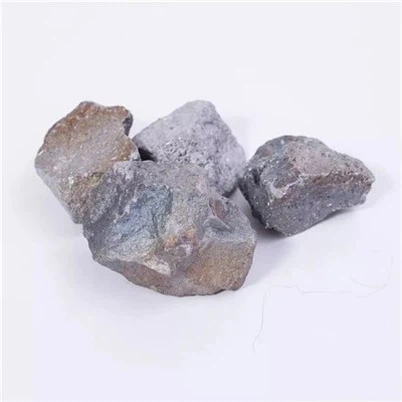
Ferromolybdenum FeMo60 and FeMo70: Grades, Uses and Price Drivers
Leave a message
Ferromolybdenum: Definition and Function as an Alloying Additive
Ferromolybdenum is a master alloy of molybdenum and iron, delivered as a brittle, silver-grey lump material that is charged into steel and alloy melts as the practical carrier of molybdenum. It exists because molybdenum metal itself melts at about 2,623 degrees Celsius, far above the temperature of a steelmaking bath, so the pure metal would neither dissolve readily nor distribute evenly. By alloying molybdenum with iron, the producer obtains a product with a much lower liquidus than the pure metal, a density close to that of liquid steel, and a dissolution behaviour that can be controlled by sizing and by addition practice.
Molybdenum is added for four technical reasons that recur across steel families: it raises hardenability so that heavy sections can be quenched to a uniform structure; it improves high-temperature strength and creep resistance; it increases resistance to pitting and to certain acid environments in combination with chromium; and it contributes to the secondary hardening response of tool and die steels. Because these effects are delivered at comparatively low addition levels, ferromolybdenum is usually the highest-value input per tonne in an alloy steel charge, which makes recovery and yield accounting more important for it than for bulk deoxidisers.
The grade notation is based on nominal molybdenum content: FeMo70, FeMo60 and FeMo55 are the designations most often traded, and this is why a purchase specification that states only ferromolybdenum is incomplete. The molybdenum content, the impurity ceilings, the sizing and the packaging must all be written down before two offers refer to the same material.
Standard Grades, Chemistry and Impurity Limits
Ferromolybdenum is standardised under GB/T 3649, which defines the designations, the chemical composition requirements, the sizing and the inspection rules for the product. The composition table below sets out the ranges normally agreed commercially; where a contract differs from these ranges, the governing limits are those written into the standard and into the agreed purchase specification, and the certificate of analysis for the lot is the evidence that settles settlement.
| Grade | Nominal Mo % | Mo range % | C max % | Si max % | S max % | P max % | Cu max % |
|---|---|---|---|---|---|---|---|
| FeMo70 | 70 | 65.0 - 75.0 | 0.10 | 1.50 | 0.10 | 0.05 | 0.50 |
| FeMo60 | 60 | 55.0 - 65.0 | 0.10 | 1.50 | 0.10 | 0.05 | 0.50 |
| FeMo55 | 55 | 50.0 - 58.0 | 0.15 | 2.00 | 0.15 | 0.05 | 0.50 |
Three impurity groups deserve separate attention. Carbon and sulphur affect solidification and the cleanliness of the final steel, so a low-carbon requirement is negotiated explicitly where the material is intended for a critical application. Silicon and aluminium are residues of the reduction process and are tolerated at higher levels in the lower molybdenum grades. Copper and phosphorus are the elements to watch when the producer has used copper-bearing or contaminated scrap in the reductant and ballast charge, because both accumulate in the melt.
Sampling for chemical analysis follows the procedures of GB/T 4010 for ferroalloys, with ISO 3713 available as an equivalent international framework, and the sampled material is reduced and analysed under the relevant method standards. Molybdenum content is the parameter on which value is calculated, which means the practical comparison between two lots is a comparison of molybdenum units delivered per tonne of alloy, not of the alloy tonnage itself. A lot declared at 55% Mo that arrives at 60% delivers more usable metal per tonne, and the same relationship holds in reverse when a lot runs below its declared range.
Production Route: From Molybdenite Concentrate to Ferromolybdenum
Almost all ferromolybdenum originates from molybdenite, the molybdenum disulphide mineral, which is recovered mainly as a by-product of copper porphyry mining and, to a smaller degree, from primary molybdenum deposits. The concentrate is first roasted in air to convert the sulphide to technical molybdic oxide and to drive off sulphur as sulphur dioxide; roasting is a controlled multi-hearth or fluid-bed operation because the temperature must be high enough to complete oxidation without sintering the product into an unreactive mass. The oxide is the traded intermediate and also the feed to the next step.
Reduction to ferromolybdenum is carried out by an aluminothermic or, less commonly, silicothermic reaction. Technical molybdic oxide is blended with aluminium granules, iron units such as clean mill scale or low-phosphorus iron scrap, and fluxing additions, and the charge is ignited in a refractory-lined reaction vessel. The reaction is strongly exothermic and self-sustaining once initiated, producing a molten metal pool of molybdenum-iron that sinks beneath a molten slag of aluminium oxide carrying the excess flux. After cooling, the ingot is stripped from the slag, cleaned, crushed and screened to the agreed sizing. Control of the aluminium to oxide ratio governs the reaction temperature and therefore the residual aluminium and silicon in the metal, while the nature of the iron units governs copper, phosphorus and sulphur.
Because the process is a batch reaction with a metal-slag separation step, quality variation is managed by lot rather than by continuous tapping: each reaction vessel produces a discrete ingot with its own analysis. That is why a certificate of analysis tied to the lot number, and a retained sample, matter more for ferromolybdenum than for products with a continuous production signature.
Melting Behaviour, Recovery and Addition Practice
Ferromolybdenum is normally charged into the furnace or ladle in the size fraction agreed for the melt shop, with 10 to 50 mm and 10 to 100 mm being the most common ranges, and with a specified tolerance on oversize and undersize. Dry, screened lumps of consistent size dissolve predictably; an unscreened lot containing both large lumps and powder behaves unpredictably, because the powder oxidises and reports to the slag or to the extraction system while the lumps dissolve late, after the finishing additions have already been made.
Recovery is therefore a function of sizing, of bath temperature and of the addition sequence. Molybdenum has a high affinity for oxygen at steelmaking temperatures, so the alloy is normally added after deoxidation is complete and, in the electric furnace or ladle, with the bath at a temperature that keeps the alloy submerged long enough to dissolve. Ferromolybdenum added on top of an oxidising slag will lose molybdenum units to the slag phase, and that loss is invisible in the purchase price but very visible in the cost per unit of molybdenum in the finished steel.
Density is helpful here. Ferromolybdenum sits at roughly 9 grams per cubic centimetre in the lump form, close enough to liquid steel that the lumps sink rather than float, which is the main reason the alloy is preferred over other molybdenum carriers in ladle metallurgy. The practical implication for the melt shop is that charging practice and sizing specification should be written together: the sizing range should be matched to the vessel, and the recovery figure used in the charge calculation should be based on measured historical performance for that sizing range rather than on a nominal figure.
How Ferromolybdenum Prices Are Formed
The dominant variable in the price of ferromolybdenum is the cost of its molybdenum units, and those units in turn are set by the technical molybdic oxide and molybdenite concentrate markets. Because most molybdenite is a by-product of copper mining, its supply responds to copper production decisions rather than to molybdenum demand, which makes the material structurally prone to supply swings that have nothing to do with steel consumption. When a primary copper operation reduces throughput or changes ore grade, the molybdenum by-product stream narrows, and the effect is transmitted into oxide and then into alloy pricing within a short period.
Conversion economics form the second component. Aluminothermic reduction consumes aluminium granules and iron units, and the cost of those inputs moves independently of molybdenum. Energy and refractories, the cost of crushing and screening, and the recovery achieved in the reaction vessel all contribute to the conversion margin. A producer with a well-controlled oxide-to-aluminium ratio achieves both a higher metal recovery and a lower residual aluminium content, so process control and product quality are commercially linked rather than separate concerns.
Demand is concentrated in a small number of steel families: alloy and stainless steels, high-strength low-alloy grades for structural and line pipe applications, tool and die steels, and welding consumables. Traction in any one of these sectors changes the call on alloy grade molybdenum and therefore changes the spread between neighbouring grades. Steel mill inventory cycles amplify the movement, because consumers of a high-value alloy tend to convert from buying behaviour to destocking behaviour quickly when prices are falling, which widens the apparent gap between offer levels in different markets.
Commercial terms complete the picture. Offers are normally expressed per tonne of alloy with the molybdenum content range stated, or per kilogram of contained molybdenum where the contract basis is element value; the two conventions must never be mixed when comparing offers. Delivery basis under the agreed Incoterms, tax treatment, payment instrument and tenor, and the cost of packing into steel drums or bulk bags all move the delivered cost. Freight, port charges and currency movement then convert an ex-works level into a landed cost. The trade customs code for ferromolybdenum falls under heading 7202.70 of the harmonised system, and export documentation must be consistent with the declared molybdenum content because duty and statistical treatment follow the declared material.
Quotation Basis, Packaging and Logistics
A complete offer states the grade and the guaranteed molybdenum range, the maximum contents of carbon, sulphur, phosphorus, silicon and copper, the sizing range, the packaging format, the quantity and its tolerance, and the full commercial basis. Ferromolybdenum is most commonly supplied in steel drums of about 100 kg or 250 kg net, on pallets where handling equipment requires them, or in one tonne bulk bags for melts that can charge directly from the bag. Each unit should be marked with grade, lot number and net weight, and the packing list should reconcile units to net tonnage so that weight can be verified against a weighbridge or a draft survey.
| Enquiry parameter | Why it changes the offer | Typical options |
|---|---|---|
| Grade and guaranteed Mo range | The contained molybdenum units define the commercial value of the lot | FeMo70, FeMo60, FeMo55 |
| C, S, P, Si, Cu ceilings | Each ceiling constrains the reductant and iron units that can be used | Standard limits or reduced carbon and sulphur for critical duties |
| Sizing range and tolerance | Drives crushing and screening yield and the melt shop recovery | 10-50 mm, 10-100 mm, 3-10 mm |
| Packaging format | Affects filling cost, handling and moisture protection in transit | 100 kg or 250 kg steel drums, one tonne bulk bags |
| Quantity per shipment | Sets the number of lots, sampling protocol and weighing method | Pallet lots to full container or vessel parcels |
| Basis and tax treatment | Ex-works, free on board and delivered levels are not comparable as quoted | Ex-works, free on board, cost and freight, delivered at place |
| Payment terms | Credit tenor is priced into the offer level | Documentary credit at sight, documentary collection, telegraphic transfer |
| Inspection and weighing | Fixes which analysis and which weight govern settlement | Producer certificate, loading survey, discharge survey, joint sampling |
Storage requirements are straightforward but not optional. The alloy should be kept under cover on a dry floor, in drums or closed bags, because moisture pick-up both adds water to the invoiced tonnage and oxidises the fines. Drums that have been punctured or opened in handling should be re-packed rather than loaded, and lots should be rotated on a first-in-first-out basis so that older material is consumed before newer receipts. For sea transport, wooden pallets must carry the phytosanitary treatment mark required by the destination market.
Applications by Steel Family and Procurement Checklist
In high-strength low-alloy structural steels, molybdenum is used together with niobium and vanadium to obtain the strength and toughness combination required for heavy sections and for line pipe grades. In tool and die steels it supports secondary hardening and hot hardness, so the alloy is specified with tight carbon and sulphur ceilings. In stainless and acid-resistant steels, molybdenum additions of a few percent raise resistance to pitting and crevice corrosion, which is why the higher-molybdenum stainless grades command premium scrap values. In welding consumables, molybdenum is added to match the deposit analysis to the parent metal, and here again the low-carbon and low-sulphur grades are preferred because weld metal toughness is sensitive to both elements.
A disciplined acceptance procedure for ferromolybdenum should cover five points. First, confirm the lot number on the certificate of analysis matches the marking on the drums or bags actually received. Second, verify weight independently by weighbridge or by draft survey before opening any unit. Third, take a sampling increment pattern that covers the whole consignment rather than the top layer of the first pallet, in accordance with GB/T 4010 or ISO 3713. Fourth, check the analysis against the guaranteed limits, with particular attention to molybdenum content and to copper and phosphorus, which are the elements that most often drift when contaminated scrap has entered the charge. Fifth, apply the sizing check by sieving a representative sub-sample against the sizing framework of GB/T 13247, because both oversize lumps and excessive fines change the effective recovery in the melt shop. Where a producer and consumer laboratory disagree, the contract should define the tie-break, normally an umpire laboratory on a sealed retained sample.
FAQ
Q: What molybdenum content should I expect in FeMo60 ferromolybdenum?
FeMo60 is a nominal designation; commercial lots are usually agreed within a range of about 55% to 65% Mo, with carbon at 0.10% max, silicon at 1.50% max, sulphur at 0.10% max, phosphorus at 0.05% max and copper at 0.50% max. The governing limits are those of GB/T 3649 as applied in the agreed purchase specification, and the lot certificate of analysis is the settlement evidence.
Q: How should I compare an offer per tonne of alloy with an offer per kilogram of molybdenum?
Convert both to the same basis before comparing. Divide the alloy price by the contained molybdenum fraction to obtain a value per kilogram of molybdenum units, then apply the same conversion to the second offer. Also confirm that both offers use the same delivery basis, tax treatment and declared molybdenum range, because a range difference of a few percentage points changes the contained value materially.
Q: Why does the price of ferromolybdenum move so much more than the price of bulk deoxidisers?
Because its value is dominated by the molybdenum unit, and most molybdenite is recovered as a by-product of copper mining, so supply responds to copper production decisions rather than to steel demand. Steel mill inventory cycles then amplify the movement, since a high-value alloy is one of the first inputs that consumers run down when they expect prices to fall.
Q: What sizing and packaging are normally supplied for ferromolybdenum?
Lumps in the 10 to 50 mm or 10 to 100 mm range are the most common, packed in steel drums of about 100 kg or 250 kg net, on pallets, or in one tonne bulk bags for direct charging. Sizing is verified by sieve analysis under the framework of GB/T 13247, and each unit should be marked with grade, lot number and net weight.
Q: Which impurities matter most in a critical steelmaking application?
Carbon and sulphur, because they affect cleanliness and weld metal toughness, and copper and phosphorus, because they accumulate in the melt and cannot be removed economically once charged. For these duties a low-carbon grade is agreed with tighter ceilings, and the reductant and iron units used in the aluminothermic reaction are constrained accordingly.
Q: How is a ferromolybdenum lot sampled and analysed?
Sampling follows GB/T 4010 for ferroalloys, or ISO 3713 where an international framework is preferred in the contract, with increments taken across the whole consignment, reduced by a documented procedure and split so that a sealed retained sample can be held for the dispute period. The analysis report should state the lot identification, the sampling plan and the results for molybdenum and the impurity limits specified in the purchase contract.