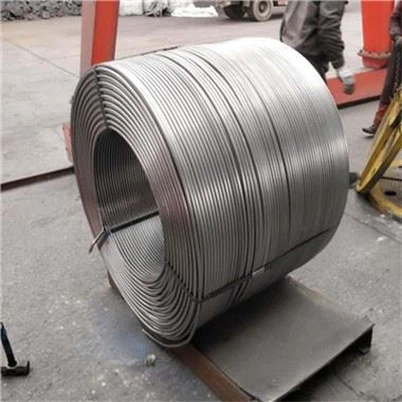


Difference Between Cored Wire
Packing: pure white packing, one pack per ton Granularity: customized according to customer requirements
Description
Products Description
Ferroalloys are used to enhance the properties of metals such as steel, copper, and aluminum. The process of adding ferroalloys to metals is known as alloying. Over the years, the conventional method of adding ferroalloys to metals has proven to be effective. However, the use of cored wire has become a popular alternative to traditional ferroalloy.
Cored wire is a type of wire made of steel and covered with a thin layer of metal powder. The metal powder within the wire is the ferroalloy that is being mixed with the metal. The cored wire is typically used in the steelmaking process, where it is fed into a ladle of molten metal. As the wire melts in the molten metal, the ferroalloy powder is released and mixed with the molten metal.
The primary difference between cored wire and conventional ferroalloy is the delivery method. Conventional ferroalloy is delivered in solid form and is often crushed into small pellets or lumps before being added to the molten metal. On the other hand, cored wire is flexible and can be fed directly into the molten metal, which is a highly efficient and precise way of delivering ferroalloys to the metal.
Another advantage of cored wire is its ability to control the amount of ferroalloy added to the molten metal. Cored wire consists of a metal wire that is encased in a metal sheath or coating. The outer layer prevents oxygen from entering the wire and causing oxidation, which can reduce the quality of the ferroalloy. The size and shape of the wire can also be customized to ensure the precise amount of the alloy is added to the metal.
Furthermore, the use of cored wire has a significant impact on the environment. The controlled delivery of ferroalloys reduces the amount of waste and emissions in steelmaking. The delivery method of conventional ferroalloy can result in the loss of some ferroalloy due to dust, breakage, or poor handling. In contrast, cored wire reduces the risk of unnecessary waste, and because the ferroalloy is delivered directly to the metal, it reduces the amount of energy and resources used in the production process.
Lastly, cored wire provides benefits to the end product. The use of cored wire in steelmaking ensures that the final product is of higher quality and consistency. Cored wire adds ferroalloy in a precise and controlled manner, which can improve the mechanical and chemical properties of the mixture. This results in a higher-quality product that is more reliable, durable, and less prone to defects.
In conclusion, while conventional ferroalloy has been used in the production of metals for years, cored wire has proven to be an equally effective and environmentally friendly alternative. The controlled delivery method, reduced waste, better final product quality, and energy efficiency have made cored wire a compelling alternative to traditional ferroalloy. With the benefits it offers, it is no surprise that cored wire is becoming increasingly popular in steelmaking and metal processing industries.


Products Content
| ype | Main composition | Inside powder weight(g/m) | Steel strip thickness(mm) | Cored wire diameter(mm) |
|---|---|---|---|---|
| CaSi | Si: 55-65 Ca: 28-35 | 230 | 0.4±0.2 | 13-13.5 |
FAQ
Q: OEM/ODM service available?
A: Yes, we accept OEM/ODM.
Q:Can we visit your company?
A:Sure,welcome at any time,seeing is believing.
Q:How about your company's certification?
A:ISO9001 and Test Report,also we could apply other necessary certification.
Contact Us
ZHENAN INTERNATIOANL CO., LTD
Fax: +86-372-5055180
Email: kevin@zaferroalloy.com
Website: www.zaferroalloy.cn
Address: 1-2510,Huafu Office Building,Anyang,Henan,China.
Hot Tags: Difference Between Cored Wire, Cored Wire, Cacium Ferro Cored Wire, Calcium Silicon Cored Wire
Send Inquiry
You Might Also Like